Showing posts with label vets. Show all posts

Monday, 11 March 2019

What’s pain got to do with it?


Pounding, throbbing pain.

Vision blurring.

Nausea rising as the bones in your skull try to separate.

Imagine feeling like that as you stand in the queue at the supermarket. And then someone crashes their trolley into you (by accident).

There’s a good chance that the words that would spill from your mouth might not be the most polite things you’ve ever said. Because when we are in pain, our tolerance goes down, we are more easily frustrated, we are more likely to lash out, and frankly everything just feels worse than normal.

But you would be able to explain to the person that you were sorry for overreacting, it’s just that right now you have a really bad headache.

Our animals don’t have that as an option.

In fact, by the time we notice that they might be in pain, things are often pretty bad. One of the first signs that our pets might be experiencing pain is often a change in their behaviour. It could be an increase in sensitivity to loud noises, or it might be your pet becoming grumpy when you ask them to move off the sofa.

Last week, I saw a lovely little beagle for a review meeting. Samson (not his real name) had completed a set of puppy visits at home some years earlier. Samson was a cheerful and friendly little dog, a real delight to work with. So, when his owners got in touch to say that he was reluctant on walks, didn’t seem to be excited to greet his family when they came home, and had started to lunge and nip at passing joggers….


There are lots of training and behaviour interventions that we might use in situations like this. For example, we might look at ways to increase interest and excitement on walks and we might start to pair up seeing joggers with getting delicious treats.

But before we jump into trying to change what the animal is doing, it’s important to check why this might be happening in the first place. Usually, this means thinking about how the animal is feeling as well as how the animal is behaving. And when there is a sudden change in behaviour especially involving apparent aggression, we always want to rule out physical problems as a contributing factor.

When I met Samson at our training venue, I had the chance to pet him as normal while I chatted to his dad. I noticed that Samson was less comfortable with being handled than he used to be, and there was some trembling in one of his back legs. So, Samson’s dad went away with a wee plan to help keep Samson safe for now while we arranged for a very thorough vet check.

It turns out that Samson was it was suffering from a very low thyroid level as well as a nasty ear infection. Both of those conditions are now being treated, and we’ve noticed a big change in Samson’s behaviour in all situations. Samson’s family still has some training to do to help make sure that Samson doesn’t carry on being worried about joggers, but we now know that the underlying painful condition is getting better.

This is just one of the reasons why professional behaviourists work on veterinary referral to ensure that your dog has no medical issues contributing to a behaviour problem. We don’t want you to waste your time trying to change a behaviour problem that has a medical cause. Medical issues which can contribute to behaviour issues range from abscesses, joint pain, thyroid imbalances, skin problems and neurological issues.

If you’re reading this and you've noticed a marked or sudden change in your dog’s behaviour, the first port of call should be a good chat with your vet. Then you will want to seek referral to a Clinical Animal Behaviourist - you can easily find these listed on the ABTC website.

Physical problems and pain don’t always underlay problem behaviours, but it’s really important that we rule them out before we dive into a training solution.

Morag Heirs PhD, Clinical Animal Behaviourist

Well Connected Canine Ltd  www.wellconnectedcanine.co.uk


What’s on at Well Connected Canine in York?


New 5 week class blocks starting on Mon 8th and Wed 10th April covering sports foundation skills, good companion obedience, sniffing school, parkour AND bodywork plus relaxation.

You can see the full programme here:
grab a weekly class!
And if you’re not sure what’s right for your dog just email me to chat it through (morag@wellconnectedcanine.co.uk)

Or if you’d rather opt for a short, sharp focused set of lessons, why not try a three week intensive to concentrate on nice walking (Stay By My Side), coming back (Baby Come Back), and polite behaviour (Mind Your Manners).

These have been really popular so make sure to book on early or you might miss your chance!

3 week intensives here


Want to try out a new sport, or dip your toes into breed specific training?

Why not check out our evening Taster Workshops


Or half day workshops (Gun Dog Games or That’s Not A Sheep – for herding breeds)


*and if you haven't already gotten the Tina Turner song as an earworm, just click here: 

You're welcome!

Monday, 4 March 2019

Getting a handle on handling!


Some dogs sail through life without a care in the world about being groomed, examined, handled and restrained…

“clipping my nails?....yeah that’s fine”
“cleaning my ears?....go right ahead”
“Vaccinations?....not a problem”

Even when these dogs are in pain or discomfort they will often let the person carry on prodding and poking away without a problem.

But for many dogs they only tolerate the weird stuff humans do to them until a painful or scary incident occurs, then they might become reluctant to be handled or may even growl or snap.

And, although we try our best, we can’t stop our dogs hurting themselves or getting ill.

So what do we do?


  •       Teach your puppy to enjoy being handled/groomed etc

  •       Learn to observe and respond to their changes in body language

  •       Involve your vet, vet nurse or groomer in the process

In both our Puppy Foundation and Puppy Life Skills classes we work on teaching the puppies to enjoy being handled, this means we break handling down into small manageable chunks and pair our touches on the puppy with tasty food rewards.

As puppy class instructor and veterinary nurse Antonia say’s ‘by teaching your puppy to love handling, you’re putting money in the bank for later’. So, when we need to make a withdrawal (usually a scary or painful unavoidable situation), we have a puppy who has lots of positive experience to fall back on and the impact of that withdrawal isn’t that great.

Our puppies are usually pretty good at letting us know when they are happy, but the signs they aren’t happy can be more subtle. You might see them turn or pull away from you, their tail may tuck slightly or they may sink to the ground a little. More obvious signs may include them mouthing at your hands, rolling over onto their back or even growling. In puppy class we teach you to observe and respond to these signs so you can adapt your training to suit your puppy’s needs.

Most vets are happy to be involved in training your puppy to enjoy visiting the practice between routine check-ups or vaccinations, it makes their lives easier in the long run if they can work with a dog who is comfortable being examined.

Check out my Border Collie Scout visiting the vet for his routine vaccination, the training we'd done made life easier for all of us, but most especially Scout! 


Spend  time now making an investment in your puppy’s future by helping them learn to love handling. We want vet visits to become a walk in the park and medical treatments taken in their stride. Necessary but scary or painful procedures should then mean a minor withdrawal from your puppy’s bank of trust.  

If your puppy isn’t comfortable being handled or isn’t happy at the vets and you’d like some extra help or support let us know,  we can help!

Happy Training

Clare and the Gang

P.s.  Our next block of classes (April 2019) are now open for booking. We’ve got a range of upcoming activities to choose from


If you’re struggling with recall, lead walking or your puppy's manner our three week intensives may be for you


Thursday, 17 May 2018

Why we want you to trust your instincts around your dog

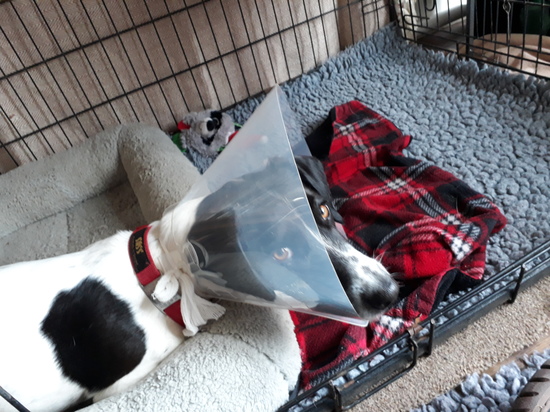
Say hi to the invalid, everyone!

Image

So, for those who don’t know, Brian has been in for knee surgery recently.  He developed a limp in September (after a wet and muddy walking holiday) which we initially thought was due to sore pads.  We tried lots of strategies to keep his pads comfortable and all seemed well.

Then the limp came back after another walking holiday in March and x-rays showed that he needed surgery.

Poor Brian!

There is a bright side to this story though. 

The specialist vet initially thought that Brian was going to need a full knee replacement (eek!) but when they came to operate, it turned out the damage to his knee was a lot less extensive than they had feared and they were able to perform a much less traumatic operation.

This is good news (both for Brian’s recovery and for my wallet!) but it got me thinking about the importance of trusting your instincts when it comes to your dog. 

When I worked in the NHS, I used to talk with my clients about combining their expertise with mine - I might be the expert on what was in the books (and I say ‘might’, because some of my clients were very knowledgeable), but they were definitely the experts in their own experience, and we needed to pull both together to find the best solutions.

The same is true for us and our dogs. 

Brian never limped at the vets (on both occasions, by the time we made it back from holiday, the limp had gone) but I knew what I’d seen and I ended up vigilantly watching in case it came back. 

As soon as it did, we took action straight away to try and get it sorted.

Because of that, Brian’s knee never got the chance to get extensively damaged and his recovery chances now are much better.

My take home message from this?

Trust your instincts.  You know your dog; you live with them day in, day out and you’re in the best position to spot when something changes. 

You’ll know when something isn’t as it usually is.

And if you act fast, it’s easier.  Whether it’s something physical that doesn’t have time to cause long standing damage, or something behavioural that doesn’t have time to become ingrained, prevention is definitely better than cure.  So, keep an eye out. 

If something changes in how your dog moves, or in how your dog acts, and you don’t understand why, check it out.  Ask your vet.  Talk to our behaviour team.  Find the right specialist.

Your dog may not thank you straight away (Brian says that puppy prison is tolerable, but the cone of shame is NOT!) but in the long run, if it is something that needs working on, you’ll definitely thank yourself!

Have a happy and healthy week!
Laura & Brian


PS If your dog isn't recovering from surgery why not book onto Sian's Introduction to Parkour.

Sunday 8th July, nr York

There's just four places left on this workshop now:
https://app.acuityscheduling.com/schedule.php?owner=13187434&appointmentType=category%3AWebinars%2C%2BSeminars%2B%26%2BWorkshops

Monday, 4 September 2017

Would your dog still love the vet?


Three trips to the vet in two days.

Having three types of liquid dripped, squirted and squeezed onto an inflamed and swollen eyeball. 

On every visit.


Holding open the sore eye, and moving the third eyelid around.

Poking things that should never be poked, and probably shouldn’t look like a peeled tomato!

You could understand if that dog didn’t really enjoy their weekend, and wasn’t thrilled by the idea of yet another check-up visit in a couple of days.

And yet, Bronte has continued to be delighted to see the receptionist, vet nurses and the night vet every single time. On Sunday morning she even fell asleep while we waited for our appointment.

I’m thrilled that Bronte loves visiting our vets, and her tolerant nature shines through even when she is clearly in a lot of pain.

But it’s not just good luck that she loves the vet.

Bronte has a remarkably gentle, sociable temperament despite a dodgy start to life. Temperament and genetics play a big part in how your dog approaches the world.

And she’s always had regular social trips to sit in the waiting room, snuggle the nurses and beg for biscuits from the receptionists.

Plus when any of my other dogs needs a vet trip (Farah has had regular acupuncture and other treatments) Bronte or Freya come along too just for the ride.

So most of the time when my girls go to the vet, it’s a fun experience and a chance to practice our mat settles and earn treats.

Dogs don’t have to be scared of the vets. It’s a lot easier for the vet to examine and treat your dog when they are relaxed and calm.

And even if your dog is a bit worried now, you can definitely change how they feel.

Get that social visit to your vets planned now, and don’t forget to ask for help if your dog or puppy doesn’t love the vet.

Wishing for a less eventful week,

Morag and the collie girls

PS We still don’t know what Bronte managed to do to her eye. She definitely traumatised her non-seeing eye somehow and while things are improving it’s not back to normal yet. 

PPS I've saved you from seeing the really icky pictures!